
A basic app with limited features costs about $30,000 to $60,000, a mid-level app with custom interfaces and backend functionality about $60,000 to $150,000, and an enterprise app about $100,000 to $500,000. The more useful budget, though, includes what you'll spend keeping the app usable after launch, not just getting it built.
A launch quote can look affordable while leaving you responsible for maintenance, infrastructure, security reviews, and service subscriptions. To answer how much does it cost to build an app, compare a defined scope and an explicit operating period, rather than treating every app-development estimate as the same product.
Table of Contents
- Typical App Development Cost Ranges in 2026
- What Drives the Price of an App
- Security and Compliance Costs for Sensitive Data
- Who Builds the App and What It Costs
- What the App Costs to Run After Launch
- How to Estimate Your Own App Budget
- Set Your Budget Range Before Requesting Quotes
Typical App Development Cost Ranges in 2026
For planning purposes, separate a limited first release from a production application with custom workflows, integrations, and operational requirements. These are budgeting bands, not fixed prices, and they aren't a prediction of what vendors will charge just because the calendar changes.
The basic, mid-level, and enterprise ranges below come from Clutch's international app-development survey, which asked 102 development companies about a project completed during the preceding year. Its estimated bands were $30,000–$60,000, $60,000–$150,000, and $100,000–$500,000, respectively.
App build cost by complexity tier
| Tier | Typical Scope | Estimated Build Cost |
|---|---|---|
| Small, narrowly scoped app | One platform, few screens, simple backend | $10,000 or less to $30,000 |
| Basic app with limited features | Core features, standard interface, limited backend | $30,000 to $60,000 |
| Mid-level app | Custom interface, backend functionality, several integrations | $60,000 to $150,000 |
| Enterprise app | Advanced features, many integrations, custom design, high reliability needs | $100,000 to $500,000 |
The small-app row reflects the small-business spending evidence discussed under builder selection, not a separate international complexity tier. Its scope description is a planning example, not a guarantee that every app with those characteristics fits that budget.
How to read the bands
A basic app should have clear boundaries. Think of a straightforward customer workflow with standard interface components, rather than a miniature version of an ambitious marketplace.
A mid-level app adds meaningful backend behavior: managing records, applying business rules, or coordinating information between services. An enterprise app may require complex permissions, custom integrations, and reliability requirements that extend well beyond what users see on their screens.
The overlap between tiers is useful. An enterprise application with a narrow workflow can overlap with a mid-level product that has extensive custom functionality.
Why an average isn't your budget
The same international survey reported that most reviewed projects fell between $10,000 and $49,999, while the average was approximately $90,780.11. That difference makes the overall average a poor substitute for a scope-based estimate.
Separately, Imaginovation's cost guide cites a Clutch survey with a 2024 median reported development price of $171,450. Treat that as sample-specific, not a figure to average together with other survey bands.
Match your must-have feature list to a tier before requesting quotes. If a proposal sits far outside its apparent band, ask which assumptions, exclusions, or technical requirements explain the difference.
What Drives the Price of an App
App development resembles a house renovation. Changing the paint color is straightforward; replacing the wiring and plumbing means opening the walls. In software, the visible interface is only part of the work.
A booking screen might look simple while relying on availability rules, account permissions, reminders, cancellation policies, and an administrator's dashboard. Count those responsibilities, not just the screens.
The renovation analogy helps separate visible choices from underlying engineering work.
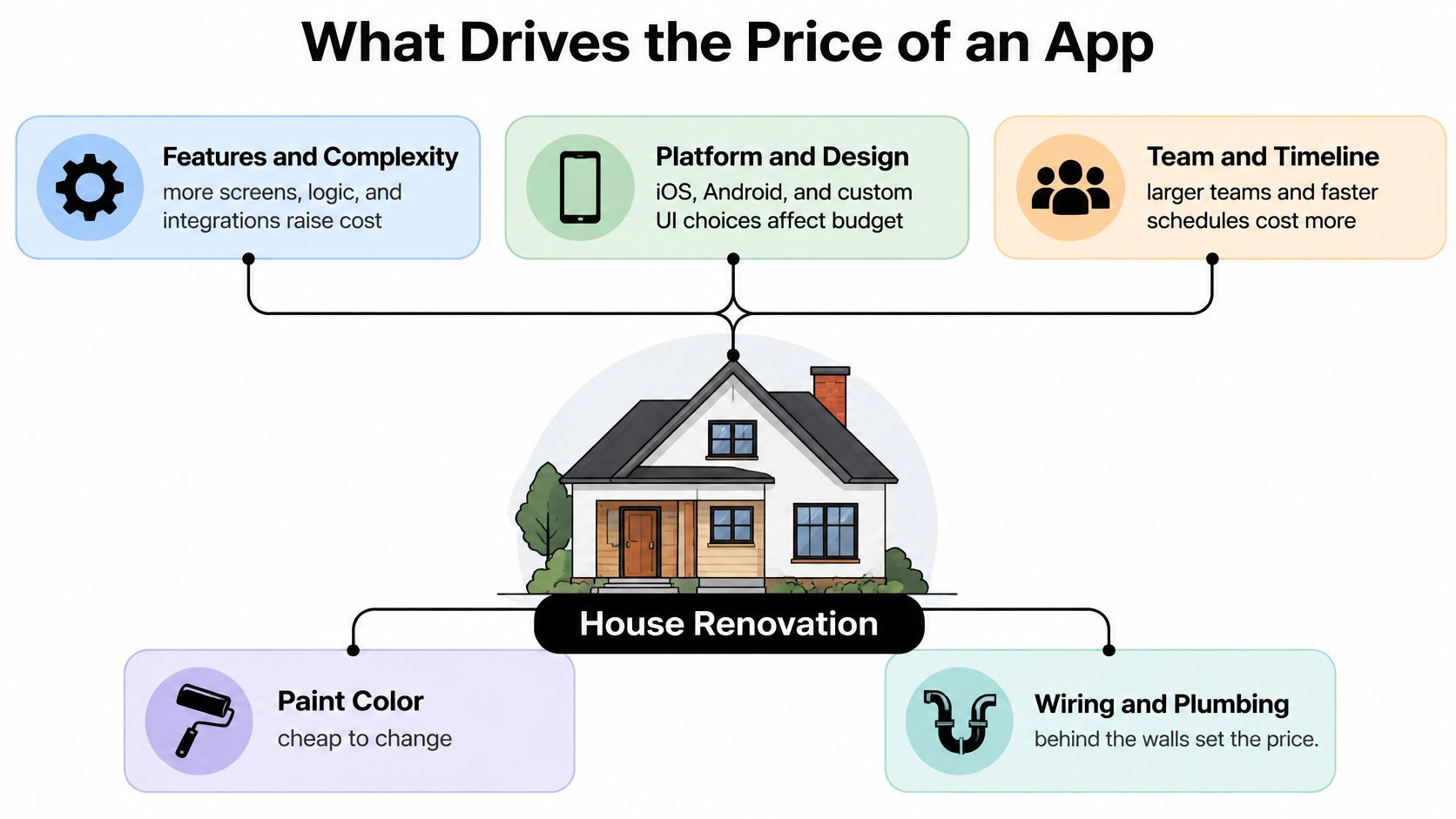
The decisions behind the estimate
- Features and logic: A form that records a booking is different from a scheduling engine that resolves conflicts and manages recurring reservations.
- Design: Standard components give designers and developers a starting point. Bespoke animations and unusual interactions require additional implementation and testing.
- Backend: Databases, APIs, server-side rules, and administration tools need specifications even when customers never see them.
- Integrations: Payments, maps, messaging, and identity services introduce credentials, failure cases, and external dependencies.
- Platforms: Shared code can reduce duplication, but developers still need to verify behavior on each supported platform.
- Team and process: Compare responsibilities, estimated effort, and deliverables, not merely an hourly rate or promised launch date.
Discovery, testing, and deployment belong in the estimate as explicit work. A vendor who prices only feature implementation hasn't necessarily priced a complete release.
Same category, different engineering
Say you're comparing two booking products. The first lets customers request appointments that an administrator approves manually. The second automatically matches providers, accepts payments, handles refunds, and supports customer-provider messaging.
Both can be described as booking apps. They aren't equivalent purchasing decisions: the second requires more business rules, transaction handling, and operational controls.
If you're considering creating an app with AI, use the same breakdown. Generating an interface doesn't remove the need to define permissions, validate workflows, or test integrations.
Scope test: Mark each cost driver low, medium, or high, then write the reason beside it. An unexplained rating isn't a specification.
Security and Compliance Costs for Sensitive Data
How much more will privacy, authentication, payments, or regulated data add? The answer depends on what the app collects and what your team must do to protect it.
The AppVerticals app-security cost guide estimates that security controls can add about 8%–15% to a conventional build and 20%–35% when regulated data is involved, with ongoing security work around $2,000–$40,000 annually, depending on sensitivity. These are planning ranges, not universal quotes, and they shouldn't be added automatically to a proposal that already includes equivalent work.
Security budgeting requires coordination between the people defining the product and those implementing it.
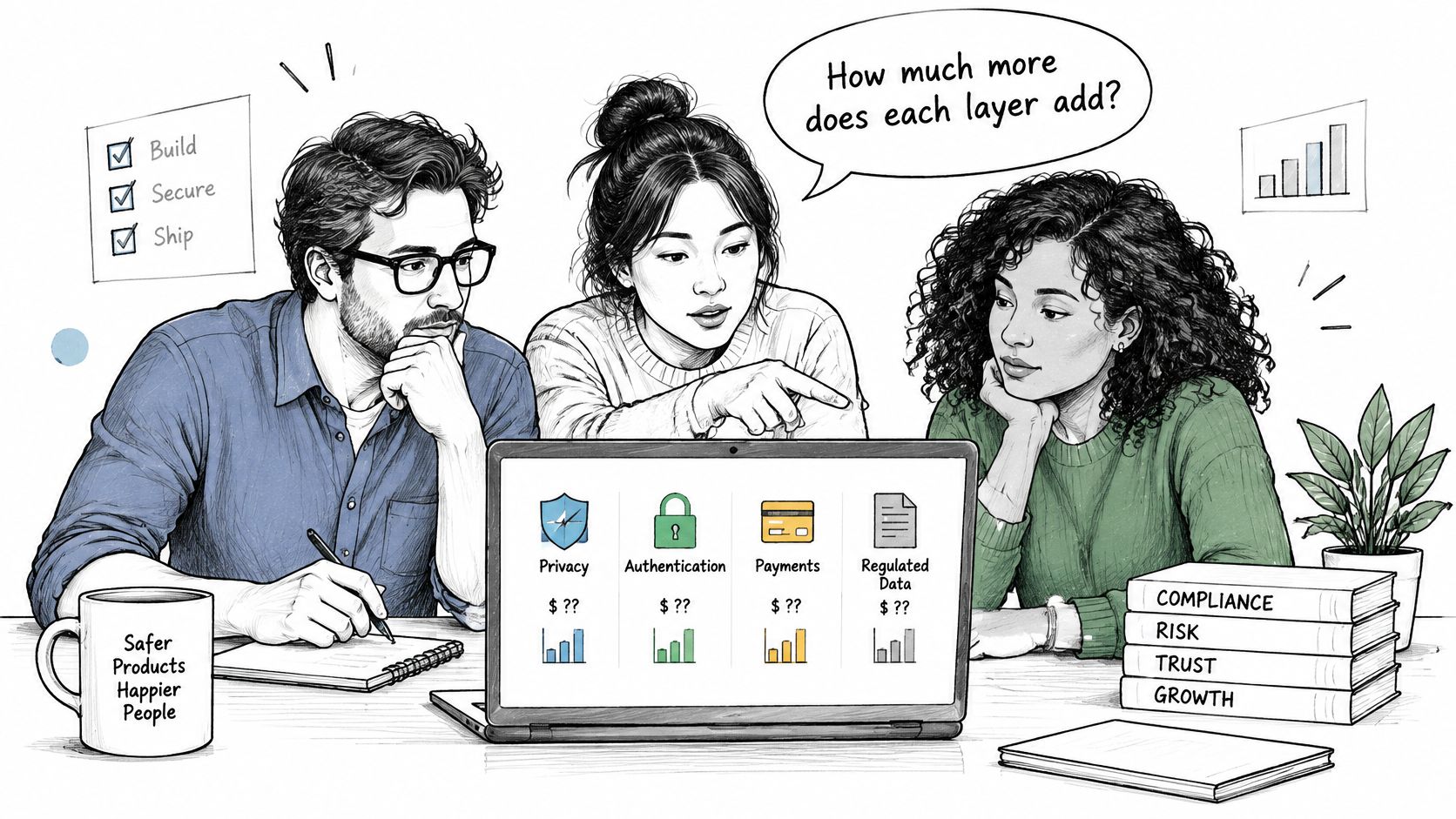
Budget around the data lifecycle
A booking app that stores contact details presents a different design problem from one that also stores payment details and health notes. Even an email address needs protection, but adding sensitive records changes the access, retention, and review questions your team must resolve.
Document the lifecycle before approving architecture:
- Collection: Identify which fields the app genuinely needs.
- Access: Specify which users and administrators can read or modify each record.
- Protection: Define encryption, secret management, and audit-log requirements.
- Retention and deletion: Decide how records expire and how deletion requests are handled.
- Operations: Assign incident response, vendor review, and monitoring responsibilities.
For translating those decisions into testable engineering work, AskYourQA's high-signal security checks for engineering teams provides a useful resource alongside your app-specific threat model.
Use the accompanying video as additional context, not as a substitute for a scoped security review.
Separate implementation from assurance
Ask vendors to distinguish security architecture, implementation, testing, monitoring, audits, and legal review. A secure login feature doesn't, by itself, establish that the entire application meets its obligations.
Adding security after developers have fixed the database structure and API behavior can require redesign. The earliest cost-control question is therefore practical: What sensitive data can this app avoid collecting at all?
Who Builds the App and What It Costs
Builder selection determines who carries responsibility when requirements change or production fails. You're buying a delivery arrangement, not just coding capacity.
In Clutch's survey of 158 U.S. small-business owners and managers, 49% of businesses using an agency spent less than $30,000, while 47% contracting freelance developers stayed below that threshold. The same survey found that 33% spent $10,000 or less overall, supporting a low-budget category without establishing that every small application can be delivered at that price.
Builder options compared on cost and risk
| Builder Option | Typical Cost Pattern | Best Fit | Main Risk |
|---|---|---|---|
| Development agency | Milestone or fixed-price quotes; surveyed agency spending summarized above | Products needing design, backend, and testing under one contract | Scope changes priced separately and unclear change orders |
| Freelance developers | Hourly or fixed fees; surveyed freelance spending summarized above | Single-platform apps with a clear specification | Dependence on one person and gaps in testing or deployment |
| In-house team | Salaries and tooling year-round; budget for the full employment commitment | Ongoing products with frequent releases | Fixed costs continue between projects |
| AI-assisted platform, such as AppJet | Free plan is enough to build and deploy a complete app; optional paid plans (more allowance, custom domains, virtual disk storage, top priority model access) and external services budgeted separately | Prototypes, internal tools, and solo builders | Limited fit as a standalone solution for very large or heavily regulated systems |
Choose the accountability model
An agency can put design, engineering, and testing under a shared delivery process. Confirm that those roles are included, and establish how changes become approved charges.
A freelancer can suit a well-defined project, especially when you can provide product direction. Require repository access, deployment instructions, and a handover plan so the app doesn't become dependent on one person's availability.
An in-house team makes sense when development is continuing work rather than an isolated purchase. For evaluating the employment side, use GENTY recruitment's developer cost guide to structure the hiring-cost discussion, then price your actual staffing requirements.
Where AI-assisted development fits
AppJet lets users describe features in plain language and helps build them. Our workspace connects to existing GitHub repositories and brings database connectivity and deployment into the development workflow.
Our Free plan costs $0 per month and is our flagship plan, with a weekly allowance that is enough to build and deploy a complete app, the AI model included, private projects, GitHub and Supabase integration, and Cloudflare global edge deployment. Check our plan comparison page for what Starter and Pro add, rather than treating a subscription as the complete project budget.
Users retain ownership of the code and content they create; we retain ownership of the platform, AI models, and improvements to the Service. That distinction matters when you're planning who will maintain or extend the application later.
The right builder is the one whose responsibilities match your scope and your post-launch staffing, not necessarily the one with the smallest initial invoice.
For a large or heavily regulated system, plan for qualified engineering and security oversight even when AI assists implementation.
What the App Costs to Run After Launch
A $100,000 build becomes a $145,000–$175,000 build-plus-maintenance commitment over three full years after launch, calculated using LaunchPad Lab's annual maintenance estimate of approximately 15%–25% of the original build cost. That calculation excludes separately billed infrastructure, commercial operations, and major new functionality.
Maintenance can cover bug fixes, operating-system compatibility, monitoring, security upkeep, and incremental improvements. The contract must specify which of those activities your provider includes.
Three-year cost of ownership for a $100,000 app
The following calculations assume a constant original build cost and the same maintenance allowance in each post-launch year. They're budgeting scenarios derived from the cited maintenance range, not surveyed ownership totals.
| Period | Maintenance (15%-25% of build) | Cumulative total |
|---|---|---|
| Launch build | $0 | $100,000 |
| Year 1 | $15,000-$25,000 | $115,000-$125,000 |
| Year 2 | $15,000-$25,000 | $130,000-$150,000 |
| Year 3 | $15,000-$25,000 | $145,000-$175,000 |
Compare every tier on the same basis
Applying that maintenance assumption to the build tiers produces the following three-year ownership baselines. Each lower endpoint uses the lower build price and maintenance assumption; each upper endpoint uses the higher ones.
| Budget tier | Calculated build plus three years of maintenance |
|---|---|
| Small, narrowly scoped app | At a $10,000 build, $14,500-$17,500; at a $30,000 build, $43,500-$52,500 |
| Basic app | $43,500-$105,000 |
| Mid-level app | $87,000-$262,500 |
| Enterprise app | $145,000-$875,000 |
A small app built below the illustrated starting amount would have a lower calculated baseline. These figures aren't all-inclusive totals: add the charges excluded from your particular maintenance agreement before comparing proposals.
- Infrastructure: Hosting, storage, databases, backups, and service usage.
- Commercial operations: Payment processing, customer support, analytics, and marketing.
- Additional development: Substantial new features or architectural changes.
- Compliance: Reviews, audits, or specialist work not covered by the support contract.
Avoid double-counting infrastructure or security when a maintenance retainer already includes them.
Keep subscriptions in proportion
Our Starter plan costs $5 per month and adds 5× the weekly allowance of Free, custom domains, and virtual disk storage. Pro costs $15 per month and includes Starter features, 20× the weekly allowance of Free, and top priority model access.
Both are monthly subscriptions and can be canceled at any time. Connected third-party services, including external hosting and database subscriptions, can have separate charges and terms.
A platform subscription buys more allowance and paid platform features such as custom domains, virtual disk storage, or top priority model access, not an outsourced operations team. Before launch, identify who handles incidents, who approves updates, and whether maintenance is a fixed commitment or separately billed work.
How to Estimate Your Own App Budget
Estimate from a written workflow outward. Starting with a preferred price and asking developers to fit an undefined idea into it encourages omissions rather than useful comparisons.
Use this visual as a starting checklist, then expand it into an estimate that includes delivery and operation.
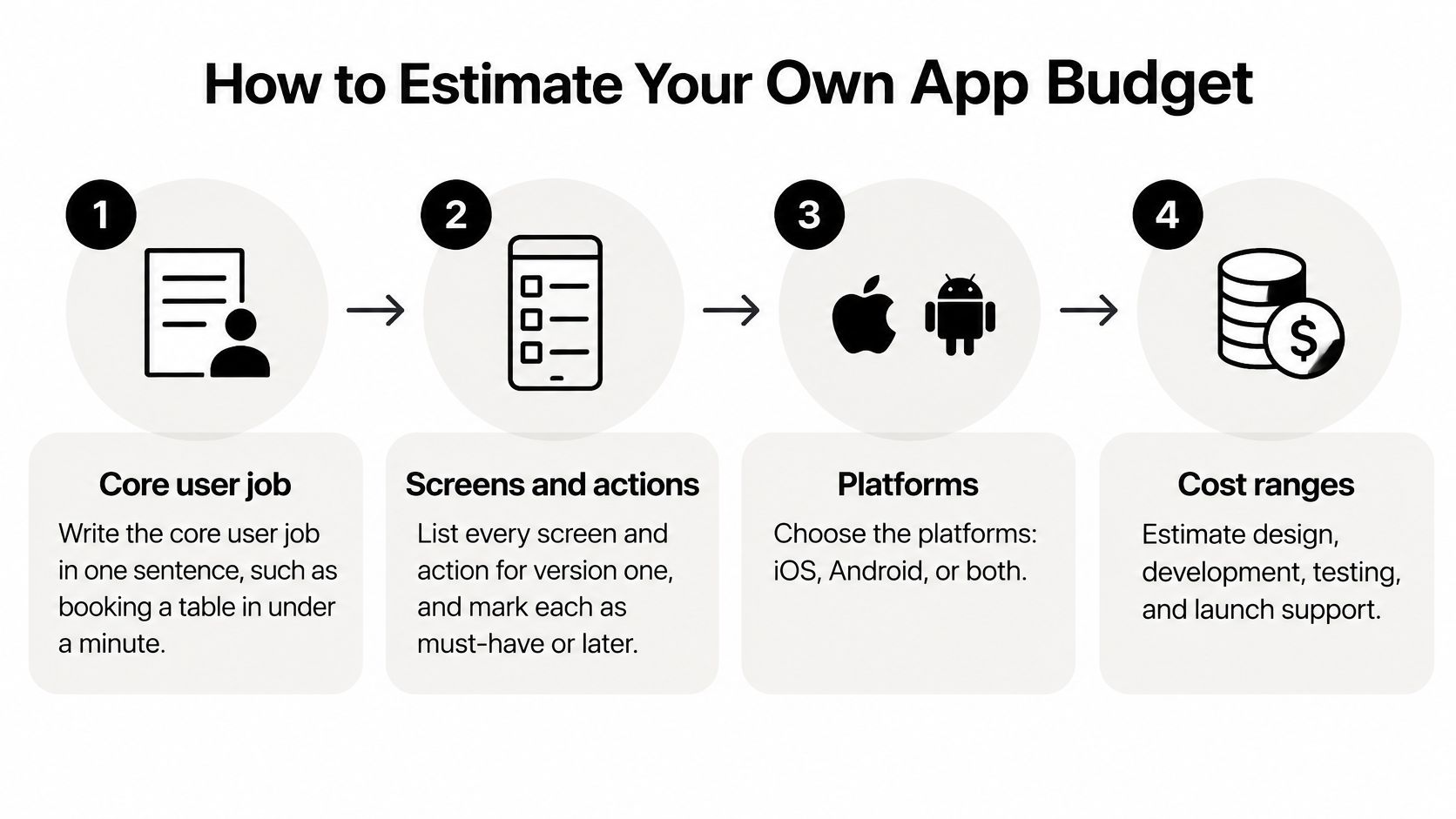
Turn the idea into estimable work
-
Write the core user job. Describe the outcome, such as allowing a customer to reserve an available table without calling. This gives you a test for whether a proposed feature belongs in the initial release.
-
List screens and actions. Include customer screens, administrator actions, error states, and account recovery. Mark each item must-have or later, rather than leaving priority implicit.
-
Choose supported platforms. Specify iOS, Android, web, or the combination your audience needs. Include device-specific capabilities so vendors don't assume a browser implementation is interchangeable with a native application.
-
Request effort ranges by feature. Have the delivery team estimate low and high effort, then apply its proposed blended rate. Require assumptions beside uncertain items, such as whether an external API already supports the required workflow.
-
Add non-feature delivery work. Include discovery, interface design, integration setup, testing, deployment, documentation, and handover. Record shared tasks separately so they aren't accidentally omitted or charged repeatedly.
-
Create an uncertainty allowance. Tie contingency to unresolved questions, such as incomplete API documentation or an untested migration. Keep that allowance distinct from optional features so you don't spend it before the uncertainty is resolved.
-
Build the operating budget. Request a maintenance proposal and itemize subscriptions, usage-based services, and support responsibilities. Extend the calculation across the same ownership period for every proposal.
-
Issue an identical quote brief. Give each vendor the same feature list, acceptance criteria, exclusions, and operating assumptions. Compare the resulting line items before comparing the headline totals.
Make uncertainty visible
For additional structure when planning your development budget, TekRecruiter's estimation guide can help organize the discussion with a delivery team. Your own estimate should still identify the specific dependencies and unresolved decisions affecting your app.
Use a spreadsheet with columns for the requirement, owner, low estimate, high estimate, assumption, and acceptance test. An assumption such as client supplies production-ready content is more useful than an unexplained contingency line.
Budget discipline: If a requirement can't be described clearly enough to test, don't treat its implementation estimate as settled.
For an unproven concept, follow an MVP development approach for startups: release the smallest useful workflow, observe whether people complete it, and fund later features from evidence. Cutting scope deliberately is different from removing testing or operational safeguards to make a quote look cheaper.
Set Your Budget Range Before Requesting Quotes
Set a launch budget, an annual operating reserve, and a contingency allowance before approaching builders. Keep them separate so a change to the initial release doesn't consume the money needed to operate it.
Use this checklist to prepare a quote brief with clear financial boundaries.
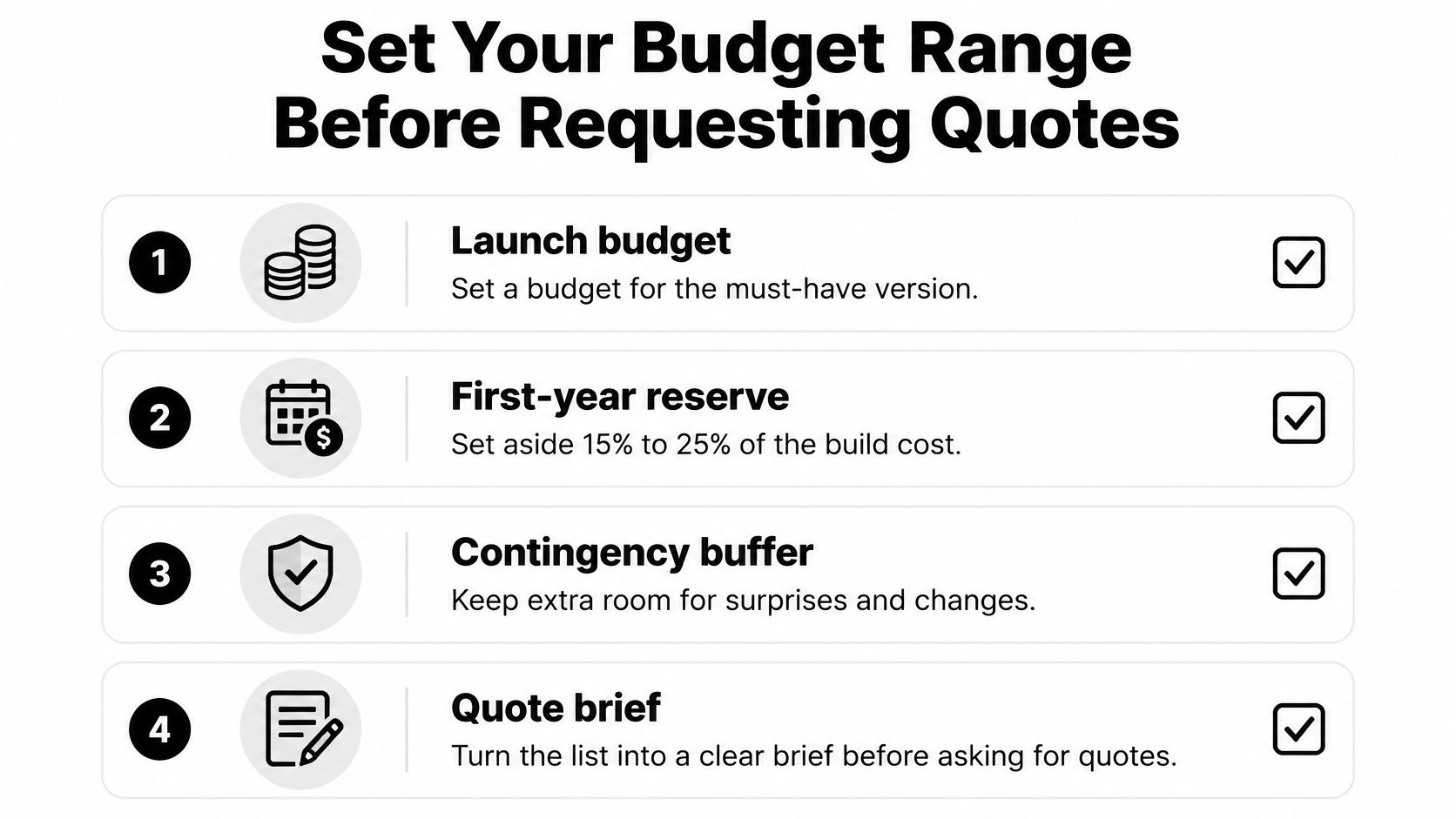
Require answers before comparing totals
- Delivery coverage: Does the price include discovery, design, testing, deployment, and handover?
- Maintenance responsibility: Who operates the application, and how are updates approved and billed?
- Service ownership: Which external accounts will you own, and which charges reach you directly?
- Sensitive data: What security work is included, and what requires a separate engagement?
- Acceptance: What must work before a milestone is considered complete?
If the idea still needs validation, our Free plan requires no credit card and supports testing a prototype through plain-language instructions. Use that experiment to clarify the workflow, not to assume that production readiness is automatic.
Your next step is to write the quote brief and attach your budget boundaries. A defensible range with explicit assumptions is more useful than a precise number for an undefined app.
AppJet combines plain-language development assistance, GitHub connectivity, database integration, and deployment in one workspace. Visit AppJet to prototype your core workflow on the Free plan and turn a broad app idea into a clearer scope before committing to a larger build.