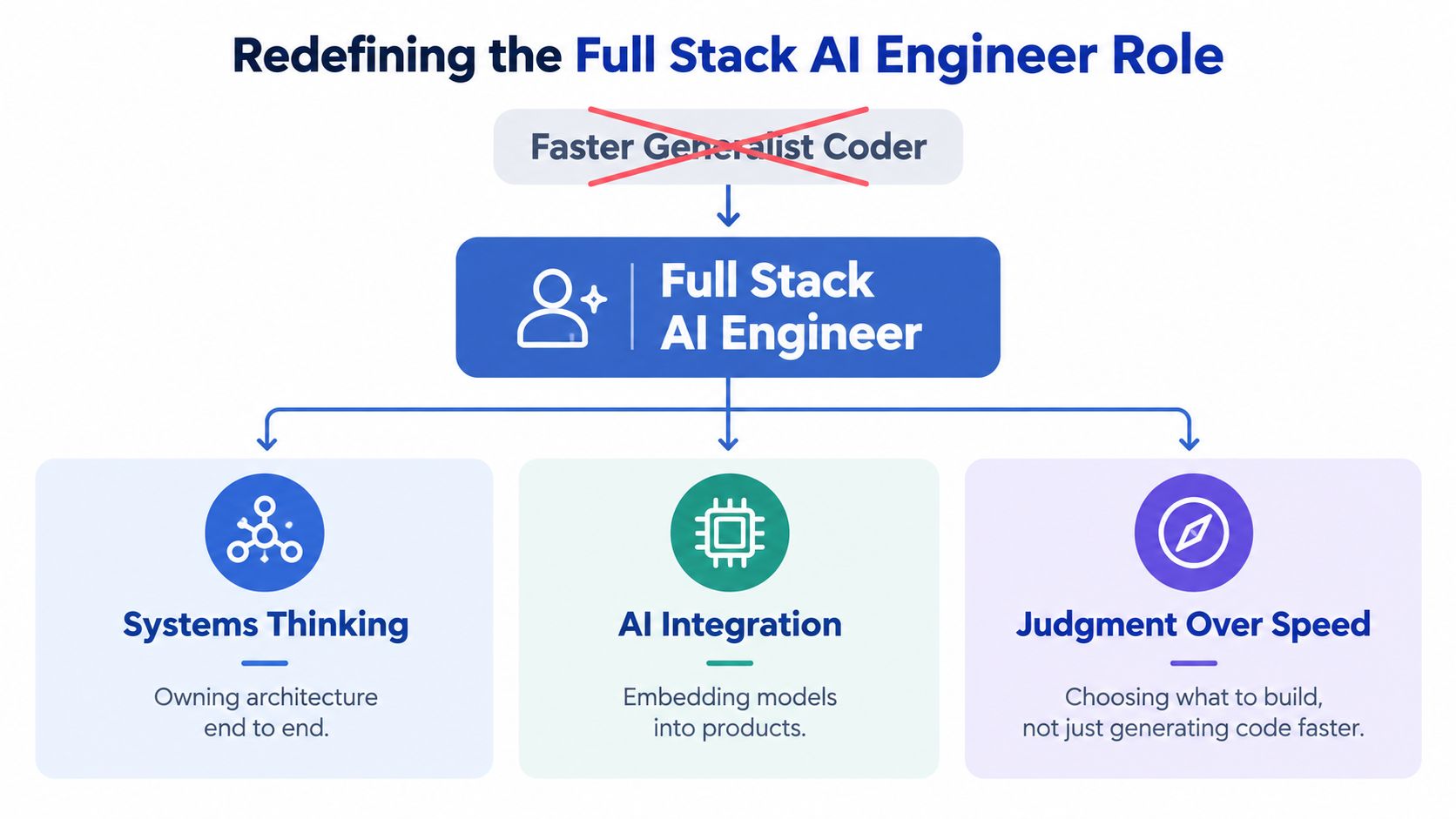
The popular advice says a full stack AI engineer should become a faster generalist coder. That advice is incomplete. AI can accelerate implementation, but production systems still fail in testing, integration, evaluation, security, and deployment. The valuable engineer isn't the person who generates the most code. It's the person who decides what deserves to be built, constrains model behavior, validates every risky change, and carries the system from a product requirement to a dependable production service.
That shift matters because AI-assisted development is already creating a gap between code production and delivery. A multi-study paper summarized by MIT Sloan reported up to a 180% increase in coding activity, compared with about 50% more projects and 30% more releases. More generated code doesn't automatically create more shipped value. It often moves the bottleneck downstream, where judgment and engineering discipline matter most.
Redefining the Full Stack AI Engineer Role
A traditional full-stack engineer connects a frontend, backend, database, and deployment environment. A machine learning engineer adds model training, data pipelines, evaluation, and inference operations. The full stack AI engineer combines these responsibilities, but the role isn't just the union of two job descriptions. It adds a third requirement: the ability to manage uncertainty introduced by AI systems.
A model can return an answer that looks plausible while using the wrong context, violating a business rule, leaking sensitive information, or producing code that passes a narrow test but breaks a wider workflow. A full stack AI engineer designs the system so those failures are visible and contained. That means defining typed interfaces, permission boundaries, fallback paths, evaluation sets, audit logs, and rollback procedures before the first model call reaches production.
Practical rule: Treat generated code and generated content as proposals until tests, reviewers, and runtime controls establish that they're safe.
The role differs from a pure data science position in that data scientists may optimize model quality, while full stack AI engineers must decide whether a model belongs in a user-facing workflow at all. They also need to understand latency, cost, accessibility, observability, database behavior, and the consequences of a wrong answer. Conversely, they aren't expected to invent a new model architecture for every product. Their strength is system integration and operational judgment.
The same principle applies to AI coding agents. A useful guide to AI agents for coding should be read as a workflow design problem, not as a promise of autonomous delivery. Give an agent a bounded task, a clear repository context, a test command, and an explicit acceptance condition. Then review the diff as carefully as you would review a change from a junior engineer.
The role's central question is no longer, “How quickly can I write this feature?” It's, “How do I make this feature correct, observable, reversible, and useful to the customer?” Engineers who answer that question well can work across the stack without confusing breadth with value.
Core Competency Pillars and Skills
The role needs a T-shaped skill profile. You need real depth in one area, usually software engineering or applied machine learning, plus working competence across the other layers. Trying to master every framework creates shallow familiarity and slows delivery.
Machine learning and data reasoning
You don't need to train foundation models from scratch, but you do need to understand data quality, embeddings, retrieval, prompt construction, fine-tuning trade-offs, evaluation design, and inference failure modes. A production engineer should know why a retrieval system returns irrelevant context, how a changing data source affects answers, and when a deterministic rule is safer than a model.
The UK government vacancy analysis found that Python appeared in 68% of AI Expert roles, while Data Science appeared in 64% and Machine Learning in 63%. The report also found that 99% of those roles required at least a bachelor's degree, with 37% requesting a PhD and 29% requesting a master's degree. These figures, documented in the AI engineering field guide skills analysis, point to a technically demanding market, though practical delivery experience can complement formal credentials.
Software engineering
Strong engineering fundamentals remain the safety layer around AI. Focus on API design, modularity, typing, testing, concurrency, error handling, version control, and code review. For Python-heavy teams, consistent conventions matter because AI tools reproduce patterns from the repository. The Python coding standards guide is useful when you need to turn those conventions into explicit, reviewable rules.
Infrastructure and operations
An AI feature is an operational service. Learn containers, cloud identity, queues, caching, secrets management, CI/CD, monitoring, tracing, and cost controls. You should be able to explain what happens when a provider times out, a retrieval index is stale, a queue backs up, or a deployment introduces a regression.
Frontend and backend product delivery
Frontend competence means more than rendering model output. You need streaming states, citations, retry behavior, accessible controls, permission-aware views, and honest error messages. Backend competence includes data modeling, authentication, rate limiting, background jobs, and integration contracts. The layers meet in the user experience. A technically accurate model still creates a poor product if the interface hides uncertainty or makes correction difficult.
A practical division of depth looks like this:
| Layer | Working capability | Production question |
|---|---|---|
| ML | Retrieval, evaluation, inference patterns | How will we measure usefulness and failure? |
| Engineering | APIs, tests, architecture, review | How will we change this without breaking users? |
| Infrastructure | Deployment, observability, security | How will we detect and recover from incidents? |
| Product UI | States, accessibility, feedback loops | How will users understand and correct the system? |
Technology Stack and Tooling
Choose tools by the failure you need to control, not by the popularity of a framework. A full stack AI engineer's stack should make local development predictable, production behavior observable, and model changes reversible.
Start with a dependable base
Python remains a practical choice for model orchestration, data processing, evaluation, and service APIs. Pair it with a typed interface, automated tests, a package manager, and a clear project layout. TypeScript is often the better choice for browser applications and can also provide a consistent contract between frontend and backend teams.
For model work, use the framework that matches the workload. A lightweight API layer may be enough for a retrieval feature. A workflow engine becomes useful when tasks require durable state, human approval, retries, and branching. Don't add an orchestration layer merely because the application includes an LLM.
Build around controls
A production stack should include:
- Evaluation tooling: Maintain representative test cases, expected behaviors, refusal cases, and regression checks. Measure more than answer similarity. Include groundedness, correctness, latency, and usability.
- Data and retrieval services: Use a relational database where relational guarantees matter, object storage for source artifacts, and a vector index only when semantic retrieval solves a demonstrated problem.
- Deployment automation: Use containers, CI/CD, environment separation, migrations, secrets management, and staged releases. A model prompt change deserves a review path just like application code.
- Observability: Capture traces, tool calls, failure categories, token usage where relevant, user corrections, and latency. Redact sensitive content before logs leave the trust boundary.
- Security controls: Enforce authorization outside the model, validate tool arguments, limit outbound actions, and keep sensitive data out of prompts unless the design explicitly permits it.
The job market reflects this operational emphasis. A 2026 analysis of 43,500 AI engineering job postings found Python in 62% of postings, cloud platforms in 55%, and foundation models in 51%. It also found observability and monitoring in 40.2%, CI/CD in 33.2%, and retrieval-augmented generation in 32.2%. The combination suggests that hiring teams want engineers who can move from model interaction to reliable operation.
Use tool catalogs such as this AI tools list to compare options, but keep the selection narrow. Every additional service adds configuration, failure modes, and operational ownership.
Project Examples and Platform Workflows
Consider an internal support assistant that answers questions from approved company documents. A weak implementation starts with a chat box and an API key. A production-minded full stack AI engineer starts with the decision the assistant is allowed to support, the sources it may use, and the action a user takes when the answer is incomplete.
Idea and prototype
Define a narrow user problem and a success condition before choosing a model. For example, the first version might answer policy questions with citations and route uncertain requests to a human. Build a baseline with a small, representative document set, then test whether retrieval provides the right passages before tuning prompts.
A traditional workflow may separate frontend work, API work, data preparation, and deployment into different queues. An AI development platform can reduce handoffs by keeping repository context available while the engineer changes several layers. For teams evaluating that approach, this AI tool building guide from SubmitMySaas offers useful product-level framing around turning an idea into a working tool.
Platform build
The engineer then creates ingestion jobs, document versioning, access controls, retrieval logic, response formatting, and the interface for citations and corrections. The important comparison is not “manual coding versus AI coding.” It's unbounded generation versus constrained iteration. An AI assistant can propose a parser, endpoint, component, or migration, but the engineer decides the boundaries and checks the result against the system contract.
A platform such as Appjet.ai can support this workflow by using repository context, isolated branches, automated testing, and edge-first deployment. Those capabilities are useful when they reinforce review and rollback rather than encouraging direct edits to the mainline.
Evaluation and deployment
Evaluation should include correct answers, missing information, conflicting sources, unauthorized documents, malformed uploads, provider errors, and slow responses. Add monitoring for retrieval failures, user corrections, and unexpected tool behavior. Deploy only after the system has a documented fallback, a rollback path, and a way to distinguish model failure from application failure.
The finished project demonstrates the full role clearly. The engineer isn't only writing a prompt or building a React screen. They're shaping the data contract, implementing the service, designing the user experience, validating behavior, and operating the result.
Learning Paths and Career Development
A strong path into this role starts with a product you can explain, not a long list of certificates. Build one small AI application end to end, then improve its reliability until you can defend every important design choice.
Build in deliberate stages
- Strengthen software fundamentals. Learn a language thoroughly enough to write maintainable services, test behavior, inspect dependencies, and debug failures. Add HTTP, databases, authentication, Git, and deployment basics.
- Learn applied AI through one workflow. Start with embeddings, retrieval, structured outputs, tool calling, and evaluation. Understand where the model can fail and where a deterministic implementation is preferable.
- Ship a complete product slice. Include a frontend, backend, persistence, background work, logging, and a deployment process. A polished notebook doesn't demonstrate full-stack ability.
- Add production safeguards. Introduce permissions, input validation, rate limits, traceable model calls, regression tests, and human review for consequential actions.
- Practice system design. Explain data flow, trust boundaries, scaling choices, failure recovery, and the trade-off between latency, cost, accuracy, and complexity.
- Document decisions. Write a short architecture note, an evaluation method, known limitations, and an incident response plan. Hiring managers can assess judgment from this material.
The order matters. Coding breadth is useful, but product thinking and system design increasingly distinguish engineers who can create durable value from those who can only assemble demonstrations. A 2026 industry survey reported product thinking at 55% and system design at 52% among the strongest growing skills, while coding depth and deep knowledge of a specific stack were reported as declining in importance. Those findings appear in the 2026 AI engineering whitepaper.
Turn projects into evidence
Choose a project with visible constraints. A support assistant with citations, a document-processing workflow with human approval, or a code-review service with regression checks gives you better interview material than a generic chatbot. Show the repository, architecture diagram, evaluation cases, failure examples, and the changes you made after observing real behavior.
Use AI tools during the build, but keep a record of where they helped and where they misled you. Candidates who can explain their verification process will stand out from candidates who only demonstrate prompt fluency. For structured practice, this resource on how to prepare for interviews with AI can complement hands-on system work.
Interview Preparation and Hiring Insights
Many candidates prepare for a full stack AI engineer interview by memorizing model APIs. That rarely addresses the difficult part of the role. Interviewers want to know whether you can turn an ambiguous product need into a system with clear boundaries, measurable behavior, and controlled failure.
Expect questions such as:
- Architecture: How would you design a retrieval system with document permissions, citations, updates, and fallback behavior?
- Evaluation: How would you create a test set, classify failures, and decide whether a model change is safe?
- Operations: What would you monitor, and how would you investigate a sudden increase in latency or incorrect answers?
- Security: How would you prevent prompt injection, unauthorized tool use, and data leakage?
- Delivery: How would you review AI-generated code and integrate it without weakening repository standards?
- Product judgment: When would you decline to use a model and choose rules, search, or a human workflow instead?
The strongest answers make trade-offs explicit. A larger model may improve difficult reasoning but increase latency and cost. Retrieval may improve grounding but introduce indexing, permissions, and freshness problems. Streaming can improve perceived responsiveness while making cancellation, partial failures, and state management more complicated.
Interview signal: Don't claim that a system is reliable because it passed a demo. Explain which failure modes you tested, which ones remain, and what the system does when they occur.
Candidates should also prepare a concise walkthrough of one shipped project. Start with the user problem, explain the architecture, identify the riskiest assumption, describe the evaluation method, and finish with a change you made after learning from failure. This structure demonstrates product thinking, implementation ability, and operational maturity in one conversation.
AI-assisted development deserves specific treatment. The 2025 Stack Overflow Developer Survey reported that 84% of developers use or plan to use AI tools, but only 33% trust the accuracy of AI outputs, while 46% distrust them. It also found that 66% described “almost right, but not quite” answers as their biggest frustration, and 45% said debugging AI-generated code takes more time. These results make verification a hiring topic, not an optional preference.
The Future Trajectory of AI Engineering Careers
The full stack AI engineer role will keep changing because the implementation layer is becoming easier to automate. That doesn't make engineering less important. It changes where expertise pays off.
Google's 2025 DORA report, as summarized in the 2026 industry survey, described 90% adoption of AI in development workflows, a median of two hours per day spent using AI, and 59% of respondents reporting better code quality. Those figures should be read alongside the trust and debugging concerns from the Stack Overflow survey. Adoption can rise while teams still struggle to validate output and convert activity into dependable releases.
The durable advantage will move toward four human-led capabilities:
- Problem selection: Identify a user need that justifies technical complexity and define what success means.
- System design: Shape boundaries between models, services, databases, tools, and people.
- Validation: Create evidence that the system behaves acceptably under normal, adversarial, and degraded conditions.
- Adaptability: Replace tools and patterns when the product, model ecosystem, or operating constraints change.
Engineers who specialize only in one vendor's API may find their skills age quickly. Engineers who understand interfaces, data quality, evaluation, security, and deployment can transfer those skills across providers and architectures. The same applies to frontend and backend work. AI may generate more of the implementation, but users still need coherent workflows, accessible interfaces, predictable permissions, and trustworthy feedback.
The best career strategy is therefore not to chase every new model release. Build a habit of testing new capabilities against real product constraints. Keep a portfolio of systems that show clear decisions, measurable evaluation, safe failure behavior, and operational ownership. Learn enough theory to understand limitations, enough engineering to ship, and enough product thinking to know when shipping is the wrong decision.
The title may remain full stack AI engineer, but the substance will increasingly resemble systems engineer, product engineer, and risk manager in one role. The people who thrive won't be those who protect every old implementation task. They'll be those who use automation to remove routine work while taking greater responsibility for architecture, judgment, and outcomes.
Appjet.ai helps full-stack teams use contextual AI to work across repository architecture, business logic, and coding patterns, with isolated branches, automated testing, rollback support, and edge-first deployment. Use Appjet.ai to turn a bounded AI project into a reviewed, deployable workflow while keeping engineering judgment at the center.