Multi cloud deployment means running workloads across at least two independent cloud providers to improve resilience and reduce vendor lock-in. Adoption is already widespread, but the architecture needs deliberate governance, or it can create more operational risk than it removes.
Your team may already be feeling the pressure. A provider region fails, the application becomes unreachable, and the incident review reveals that the supposed backup depends on the same identity service, network path, or database connection as the primary system. Moving workloads to another provider would help, but only if the two environments can be operated as one dependable platform.
That distinction defines practical multi cloud deployment. It isn't just duplicating servers in another account. It means coordinating identity, policy, networking, data, observability, and release operations across independent providers. The strongest designs start with a business constraint, then add only the complexity needed to address it.
Why Multi Cloud Deployment Exists
A regional outage is the moment many teams discover that “cloud-based” doesn't automatically mean resilient. The application may run behind a managed load balancer, store data in a replicated database, and deploy through an automated pipeline. Yet if every component lives with one provider, a provider-wide failure can still interrupt the entire service.
Multi cloud deployment is the architectural response to that concentration risk. A team can place selected workloads with separate providers, keep a recovery environment available, or route users toward an independent endpoint when a provider failure affects the primary path. The objective isn't to make every component identical. The objective is to create failure domains that don't share the same control plane or operational dependency.

The business reasons behind the move
Vendor lock-in is one driver. A system that depends heavily on one provider's proprietary database, networking model, and deployment controls may become expensive or risky to move. Using portable interfaces and more than one provider can preserve negotiating power, although portability itself creates engineering work.
Regulatory constraints can be another. Data residency rules, acquisition-driven standardization, and workload-specific service requirements may force an organization to operate across separate environments. In those cases, multi cloud isn't a fashionable resilience project. It's a response to how the business must store, process, or deliver data.
The historical adoption pattern supports that interpretation. The 2018 RightScale State of the Cloud report found that 81% of enterprises had a multi-cloud strategy, while 51% had a hybrid cloud strategy. A later HashiCorp global cloud strategy survey, based on more than 3,000 respondents, reported that 76% already worked in multi-cloud environments, and 86% expected to use multi-cloud within two years. These figures show adoption, not automatic success.
Practical rule: Add a second provider to solve a named business or reliability problem. Don't add it merely because a reference architecture makes the diagram look more sophisticated.
What Multi Cloud Deployment Actually Means
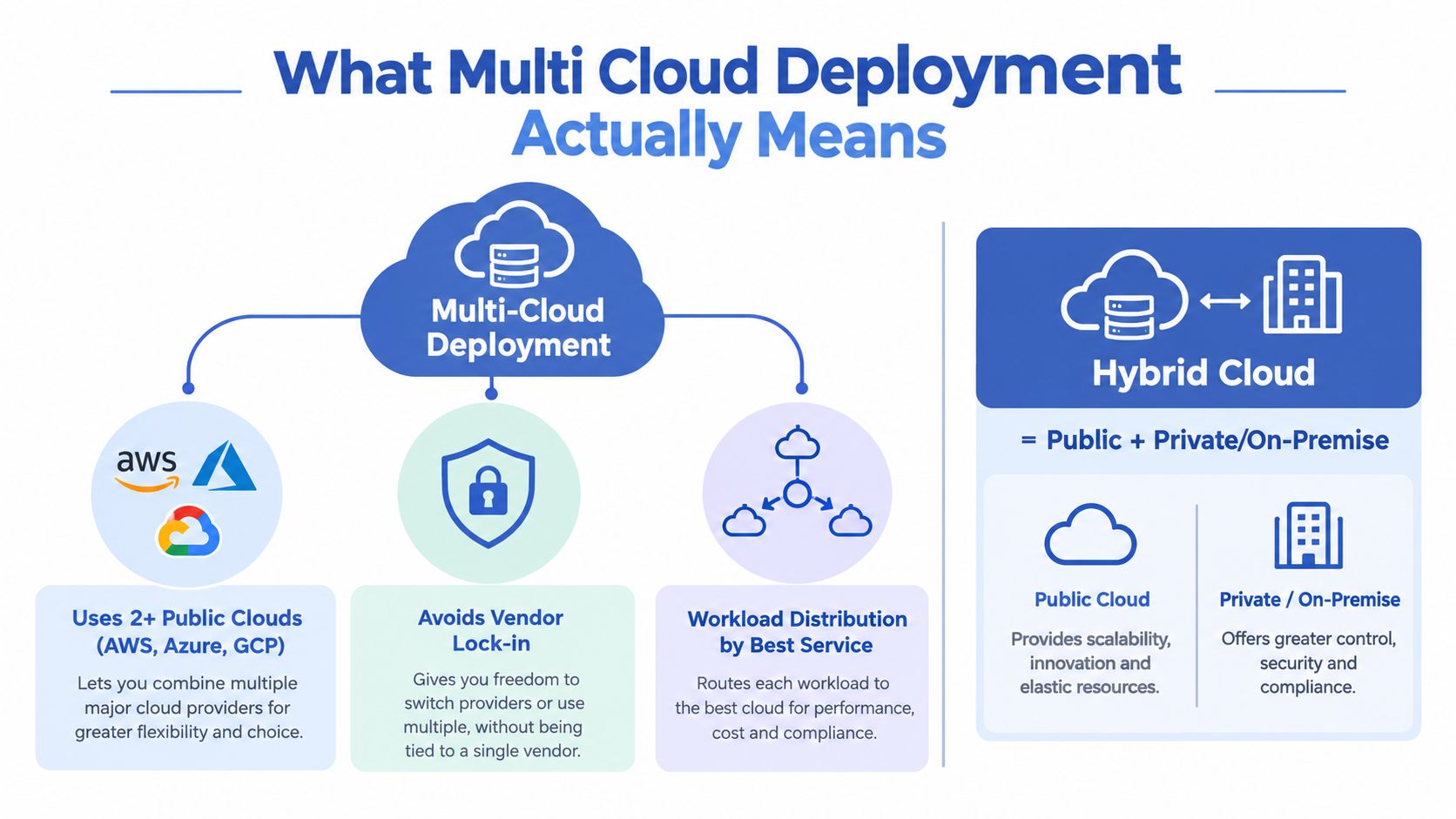
Multi cloud deployment uses services from two or more independent cloud providers as part of one operating strategy. Those providers might host separate applications, active replicas, recovery capacity, or specialized services. The important point is that the environments belong to distinct public-cloud ecosystems, with different APIs, control planes, regional footprints, and failure modes.
A workload doesn't need to be split evenly. One provider might run the customer-facing API, another might host a batch-processing service, and a third-party managed database might support a specific data requirement. The architecture becomes multi-cloud because the system relies on more than one cloud provider, not because every component runs everywhere.
Multi-cloud versus hybrid cloud
The confusion usually starts with hybrid cloud. Hybrid cloud combines public-cloud infrastructure with private infrastructure, such as an on-premises data center or a dedicated private environment. Multi-cloud focuses on multiple providers. An organization can use both approaches at once, but they answer different questions.
| Model | Core arrangement | Typical reason |
|---|---|---|
| Multi-cloud | Two or more public-cloud providers | Provider choice, resilience, regional reach, or specialized services |
| Hybrid cloud | Public cloud plus private or on-premises infrastructure | Data control, legacy integration, residency, or gradual migration |
| Multi-cloud hybrid | Multiple providers plus private infrastructure | Complex regulatory, operational, or organizational requirements |
A control plane may coordinate clusters across providers, but that doesn't erase provider-specific behavior. Compute scheduling, managed databases, secrets systems, identity roles, network policy, and monitoring still need explicit treatment. The most reliable teams define a portable application boundary while accepting that some infrastructure remains provider-specific.
For a concise comparison of the terminology and operating implications, review these key differences explained. The distinction matters during planning because a hybrid migration may preserve one public provider as the primary platform, while multi-cloud introduces independent provider governance.
Common Multi Cloud Architecture Patterns
No single topology makes a multi-cloud system resilient. The right pattern depends on whether the application can tolerate downtime, how its data is written, and whether users need a nearby endpoint.
Workload splitting
The simplest model assigns different workloads to different providers. A web application might run on one provider, while analytics, media processing, or development environments run on another. This can reduce concentration and let teams select a suitable managed service for each workload.
The weakness is that workload splitting doesn't automatically provide failover. If the primary API fails, a separate analytics provider won't keep customer traffic online. This pattern is often a sensible first step for teams seeking service choice, but it shouldn't be marketed as active resilience unless the dependencies are genuinely independent.
Active-passive recovery
An active-passive design runs the main workload on one provider and keeps recovery capacity with another. The secondary environment may be warm or may require deployment and data restoration during an incident. This approach limits duplicated runtime cost, but recovery depends on tested automation, usable backups, identity availability, and a network route that doesn't share the original failure.
Active-active delivery
Active-active deployment serves traffic from multiple providers at the same time. A global routing layer directs users to healthy targets, while application state and data replication keep replicas consistent enough for the workload. This can improve availability and user experience, but it creates the hardest problems around writes, conflict resolution, schema changes, session handling, and observability.
A study of web services deployed across three cloud providers found that users in 20% to 50% of measured network prefixes saw at least a 20% reduction in round-trip time compared with single-cloud deployments, as reported in the OpenReview network study. The benefit depends on geography, provider regions, and intelligent routing, so teams should measure their own traffic rather than assume uniform improvement.
| Pattern | How it works | Best for | Complexity |
|---|---|---|---|
| Workload splitting | Different services use different providers | Service specialization and gradual adoption | Moderate |
| Active-passive | One provider serves traffic, another provides recovery capacity | Disaster recovery with controlled duplication | High |
| Active-active | Multiple providers serve traffic concurrently | Strict availability and geographic performance needs | Very high |
| Federated control plane | A shared management layer coordinates separate environments | Teams operating portable clusters consistently | High |
Costs and Risks of Multi Cloud Deployment
A second provider does not create resilience by itself. The application must authenticate, route, observe, and recover independently across both environments. Otherwise, the architecture adds another set of dependencies without removing the original failure modes.
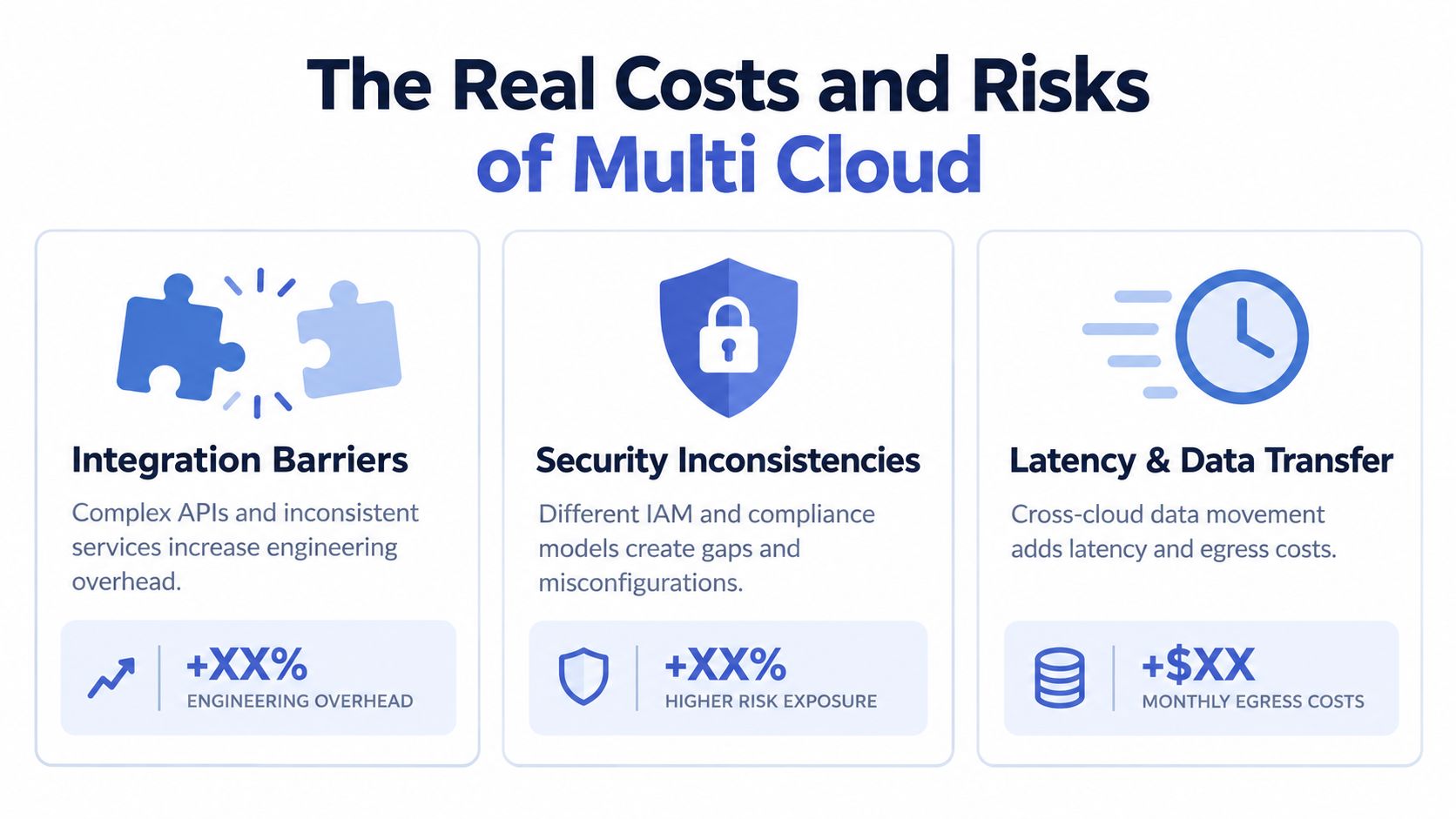
The operating burden grows quickly. One independent analysis reported that 76% of organizations encountered substantial integration barriers, with security harmonization and networking compatibility among the main problems. It also reported 82% experienced security policy inconsistencies, 41% had critical interconnection vulnerabilities, 78% struggled with IAM integration, and 72% saw latency increases from unoptimized traffic patterns in multi-cloud environments. These figures appear in the independent enterprise deployment analysis.
Where teams usually lose control
Identity becomes the first fault line. Provider-specific roles, service accounts, group mappings, and token lifetimes drift apart. A user with the correct access in one environment may receive excessive permissions in another. An outage affecting a central identity dependency can also affect both clouds.
Networking creates invisible coupling. Cross-cloud traffic may take a longer path than expected, pass through inspection points inconsistently, or incur transfer charges. An architecture that appears independent can still rely on one interconnection, DNS strategy, or routing service.
Policy drift weakens security. Encryption, retention, logging, vulnerability management, and admission controls often use different provider defaults. Policy-as-code and automated validation keep those differences visible and enforceable. A spreadsheet updated after each release cannot provide the same control.
Governance therefore determines whether multi-cloud improves availability. Teams need clear ownership for identity, routing, policy exceptions, incident response, and recovery testing, not only a count of deployed providers.
A modernization review helps when legacy dependencies or unclear ownership limit the design. Teams choosing a modernization partner should request an inventory of shared dependencies, failure-mode analysis, and measurable exit criteria rather than a provider-count target.
Multi-cloud removes a single provider from the failure story only when the team also removes shared operational dependencies from that story.
Tooling and CI CD for Multi Cloud Workloads
The tooling strategy should make provider differences explicit instead of hiding them behind a vague abstraction. Infrastructure-as-code defines the common intent, provider modules implement local details, and policy checks prevent an environment from drifting beyond approved boundaries.
Terraform or OpenTofu can manage resources across providers, while Kubernetes and Helm can standardize application packaging where Kubernetes is appropriate. GitOps tools such as Argo CD or Flux can reconcile declared state, but they don't solve identity, data consistency, or provider-specific networking. A portable deployment mechanism is useful only when the workload itself has portable operational assumptions.
Build one delivery contract
A practical pipeline should promote the same application artifact through controlled environments. It should also validate cloud-specific prerequisites before deployment.
- Source and artifacts: Build once, sign the artifact, and store immutable metadata with the release.
- Infrastructure changes: Review provider modules separately from application changes, then run policy checks before provisioning.
- Secrets and identity: Retrieve secrets at runtime through approved systems, and use federated workload identity rather than long-lived credentials.
- Progressive delivery: Shift traffic gradually, compare health signals, and keep rollback paths available in every provider.
- Observability: Send logs, metrics, traces, deployment events, and audit records into a consistent operational view.
Teams should also separate platform failure from application failure. A provider API error, an expired federation trust, a broken route, and a bad application release need different alerts and runbooks. Centralized dashboards help, but local provider telemetry remains important during a control-plane incident.
For teams comparing release automation approaches, this overview of continuous deployment tools provides useful context. Appjet.ai can also support repository-aware coding and deployment workflows, including isolated changes and automated testing, but it shouldn't replace the platform controls that govern cloud infrastructure.
Security and Compliance in Multi Cloud Environments
Security is where multi-cloud designs either become disciplined or become fragile. Compute can be recreated. Identity mistakes, untracked data movement, and inconsistent audit records can expose every environment at once.
Start with a provider-neutral identity model. Map workforce groups and workload identities to a common access vocabulary, then translate that vocabulary into each provider's native roles. Enforce least privilege, multifactor authentication for human access, short-lived credentials, separation of duties, and automated deprovisioning. Test the failure path too. A backup cloud that can't authenticate during an identity-provider disruption isn't an independent recovery environment.
Make policy executable
Policy-as-code should cover resource exposure, encryption, approved regions, network boundaries, image provenance, logging, and retention. The policy engine must run during pull requests and again at deployment, because a compliant template can still produce an unsafe result after variables and provider defaults are applied.
Compliance also needs a shared evidence model. Define which logs prove access control, where audit records are retained, who can alter them, and how investigators correlate events across providers. Data residency requirements should be encoded into placement rules, not left to individual deployment decisions.
A practical reference for teams that need to design multi cloud security patterns can help expose gaps in federation, segmentation, and monitoring. For implementation workflows, DevOps automation tools can help organize repeatable checks, but automation must enforce approved policy rather than merely accelerate deployment.
The business case deserves equal scrutiny. If multi-cloud exists only as a general preference, the security team inherits a larger control surface without a clear benefit. If residency, acquisition integration, provider-specific capability, or tested availability requirements justify it, document those constraints before choosing services.
When Multi Cloud Deployment Makes Sense
Multi-cloud makes sense when a specific business constraint justifies the added operating burden. High availability qualifies only when the recovery design removes shared dependencies and the team can fund regular failure testing. Data residency can justify separate providers when workloads must stay in different jurisdictions or move only between approved environments.
Provider diversity may also fit a workload with a specific database, accelerator, regional footprint, or managed service that another provider cannot supply appropriately. A measurable latency target supports the choice when routing tests show that the second provider improves real user paths, rather than adding another deployment location.
The decision should start with governance, because identity, policy, and traffic engineering determine whether a second provider improves availability or creates more failure modes.
Use a decision screen before designing
Ask these questions in order:
- What failure or business constraint are we addressing? State it operationally, such as recovery independence, residency, latency, or provider capability.
- Which components must be independent? Separating stateless compute while leaving identity, data, or routing on one provider may fail the stated objective.
- Can the team operate both environments? Include on-call ownership, incident response, patching, compliance evidence, identity administration, and provider-specific expertise.
- What will we measure? Define recovery behavior, routing health, data consistency, deployment correctness, policy compliance, and authentication failure handling before migration.
- What is the exit condition? If the second provider does not improve the selected outcome, the team should have a documented path to simplify.
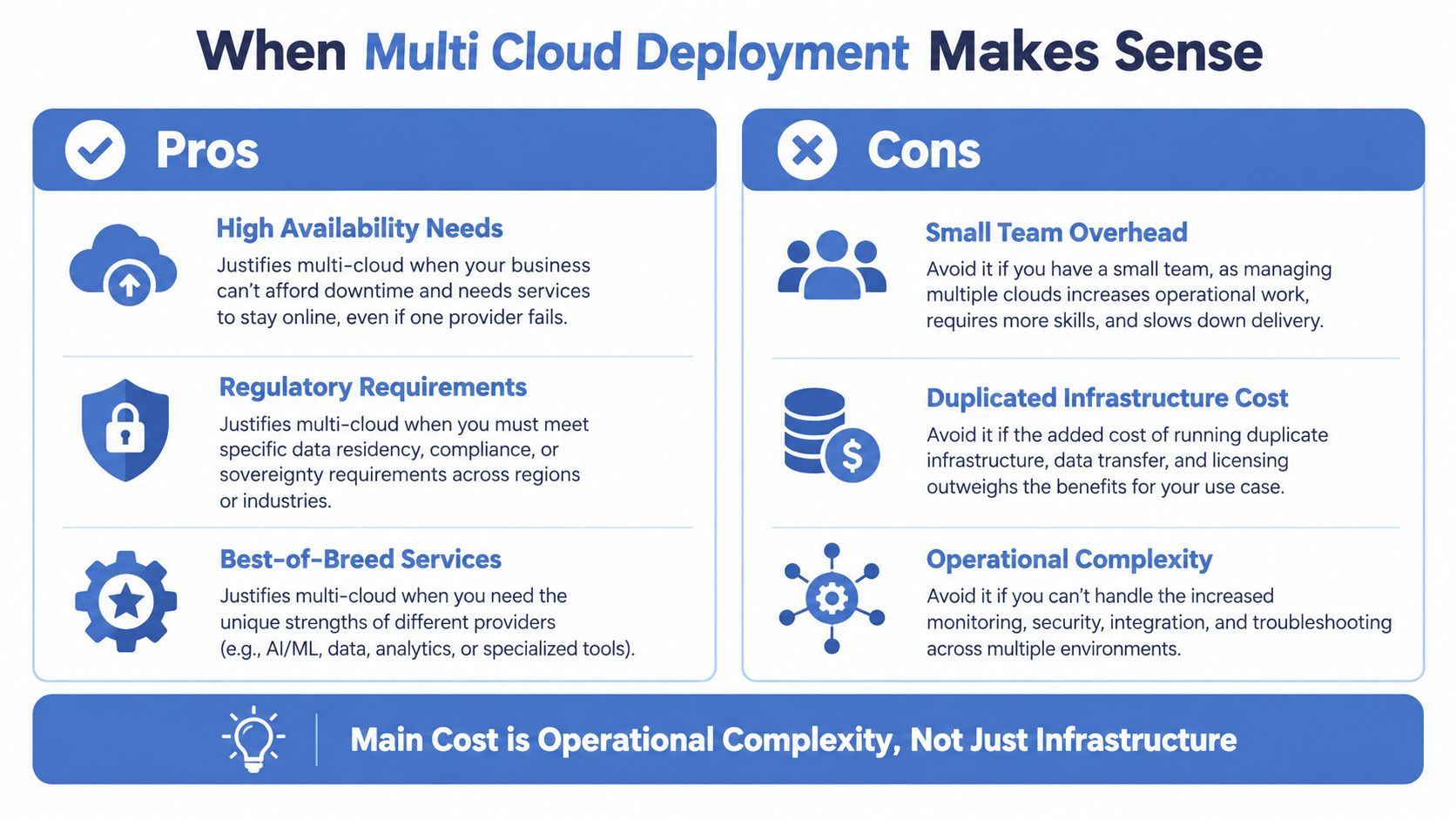
Adoption is common, but it does not prove that every team needs this architecture. Fortinet reports that 88% of organizations operate in hybrid or multi-cloud environments, 81% of those organizations rely on two or more providers for critical workloads, and 29% use more than three. Those figures support screening the business case, not skipping it. A second provider earns its place only when the team can operate its identities, policies, and traffic paths under failure conditions.
Migration Checklist and Real-World Examples
A migration can fail even when every workload deploys successfully. If identity federation breaks, policies differ by provider, or traffic shifts to a stale replica, adding a second cloud creates more failure modes rather than better availability. Treat the work as an operational redesign.
A staged migration path
- Inventory the estate: Record runtime assumptions, provider-specific APIs, data classifications, owners, and recovery procedures.
- Map identities: Define human groups, service accounts, federation paths, token behavior, privileged roles, and emergency access.
- Design data placement: Identify the authoritative copy, replication behavior, backup restoration process, and permitted transfers.
- Build the network model: Document ingress, egress, routing decisions, inspection points, service discovery, and failure behavior.
- Create the delivery contract: Use infrastructure-as-code, immutable artifacts, automated tests, policy checks, and repeatable rollback.
- Instrument before cutover: Standardize dashboards and alerts for application health, provider health, identity, networking, replication, and deployment state.
- Test real failures: Exercise provider API disruption, route loss, credential failure, stale replicas, partial deployment, and recovery procedures.
- Start with one bounded workload: Choose a service with clear ownership and limited state before expanding the pattern.
The governance burden deserves more attention than provider count. Fortinet's report cites 63% of security teams naming complexity as their primary challenge, while 95% say managing identities and entitlements across clouds is at least a minor challenge. Those findings reinforce a practical test: every identity, policy, and traffic decision needs an owner and a defined failure response.
The economics extend beyond duplicated compute. Flexera's 2026 State of the Cloud summary identifies cost savings as the top reason for cloud decisions, while only 14% of organizations operate exclusively in a multi-cloud environment without a private cloud. Data movement, duplicated observability, specialized staffing, and parallel security controls can erase expected savings without a clear operating model.
Start with a controlled cutover. Validate deployment parity, authentication, policy enforcement, routing, replication, rollback, and recovery evidence before moving additional services. For repeatable releases and environment changes, deployment automation can standardize testing, approvals, and rollback. Automation reduces manual variation, but it does not replace ownership or failure testing.
A small team may gain more from one primary provider and a tested recovery environment than from active-active production. A regulated enterprise may accept the operating burden because residency and independent recovery are required. The architecture should follow that constraint.
Appjet.ai helps development teams work across full-stack repositories with context-aware coding, isolated branches, automated testing, and deployment workflows that can support edge-first delivery. Visit Appjet.ai to evaluate its fit within a governed multi-cloud or distributed deployment process.