
The popular advice on how to create a social media app starts with profiles, a feed, and messaging. That's the wrong starting point. Before people can publish anything, decide who can see it, who can remove it, and what happens when someone abuses the system.
Build permissions, privacy, and moderation into the first release, not a cleanup sprint after launch. A small team can operate a useful community without copying every feature of an established network. It can't responsibly operate one without clear access rules and someone accountable for enforcement.
Table of Contents
- Build Roadmap From Idea to Launch
- Scope the First Version Around One Community
- Set Up Accounts, Sessions and Permissions
- Privacy Choices That Shape Your Database
- Design the Feed, Data and Media Pipeline
- Moderation Operations From Day One
- Pick Your Build Path and Launch a Beta
Build Roadmap From Idea to Launch
Use 3–6 months as an initial planning reference, not a delivery promise. APPWRK's 2024 development-cost guide estimates social-networking app development at approximately $60,000 to more than $300,000, with timelines of about 3–6 months and potentially 9 months or longer. Your scope, integrations, and operational requirements determine where your project belongs.
A focused release means a defined community, accounts, posts, follows, and reporting. Direct messages, elaborate video tools, and personalized ranking need their own justification. Don't include them merely because larger platforms have them.
Build phases, outputs and typical durations
The phase-level timing below is qualitative. Estimate actual durations after the team has reviewed dependencies and acceptance criteria, rather than dividing the overall budget into equal blocks.
| Phase | What You Produce | Typical Duration |
|---|---|---|
| Scope and validation | One-page scope, target community, launch metric | Short discovery phase |
| Accounts, sessions and permissions | Auth flow, threat model, role and permission matrix | Foundational build phase |
| Core data model and feed | Schema, chronological feed, post and follow endpoints | Focused implementation phase |
| Moderation and privacy controls | Report queue, block and hide, deletion workflow, retention rules | Cross-cutting implementation and review |
| Media, notifications and messaging | Upload pipeline, alerts, direct messages if in scope | Highly scope-dependent |
| Testing, deployment and beta | Load tests, staging, monitoring, invite-only beta | Dedicated release phase |
This order doesn't mean postponing safety decisions until the moderation row. Define those requirements during discovery and enforce them through the identity layer. The later phase supplies the reviewer interface, deletion jobs, and operational workflows.
Planning rule: A feature isn't scoped until you've described its abuse cases and who will handle them.
Media and moderation deserve explicit contingency. Video introduces processing, storage, failure recovery, and review work. Moderation requires decisions about policy and staffing that a code generator can't make for you.
Mark every deliverable MVP, later, or never. Estimate only the MVP work, identify what can run in parallel, and include release checks and operational preparation. That produces a timeline you can defend instead of a launch date based on the easiest screens.
Scope the First Version Around One Community
Pick a community with a repeatable reason to interact, then design for mobile use. At the start of 2025, approximately 5.78 billion people used mobile phones, representing 70.5% of the world's population, according to DataReportal's global digital overview. That supports a mobile-first approach, though your own audience research should determine device priorities.

A climbing gym's members sharing routes is a clearer starting point than a network for everyone who enjoys fitness. A freelance designers' critique circle also gives you a concrete interaction to support: publish work, request feedback, and respond.
Write the loop before drawing screens
Make these decisions explicit:
- Community: Name the people who'll join and how you can reach them.
- Core behavior: Describe what someone posts, why another member responds, and what brings the original poster back.
- Launch metric: Choose a return-rate or contribution measure that reflects that behavior, rather than registration totals.
- Exclusions: Cut stories, live video, creator payments, cross-posting, and algorithmic recommendations unless the core behavior requires them.
Our guide to MVP development for startups can help turn those choices into a bounded release. The useful output is a list of acceptance criteria, not a long feature backlog.
Mobile constraints should shape those criteria. Compress uploads, preserve an unfinished post when connectivity drops, and make error recovery usable on a small screen. Don't let a failed upload erase someone's writing.
A workable scope statement might read: This app helps members of a climbing gym share route attempts and exchange advice. Members return when someone responds, and useful discussions encourage invitations. We'll judge the beta by whether newly joined members return and participate, not by how many accounts we collect.
Set Up Accounts, Sessions and Permissions
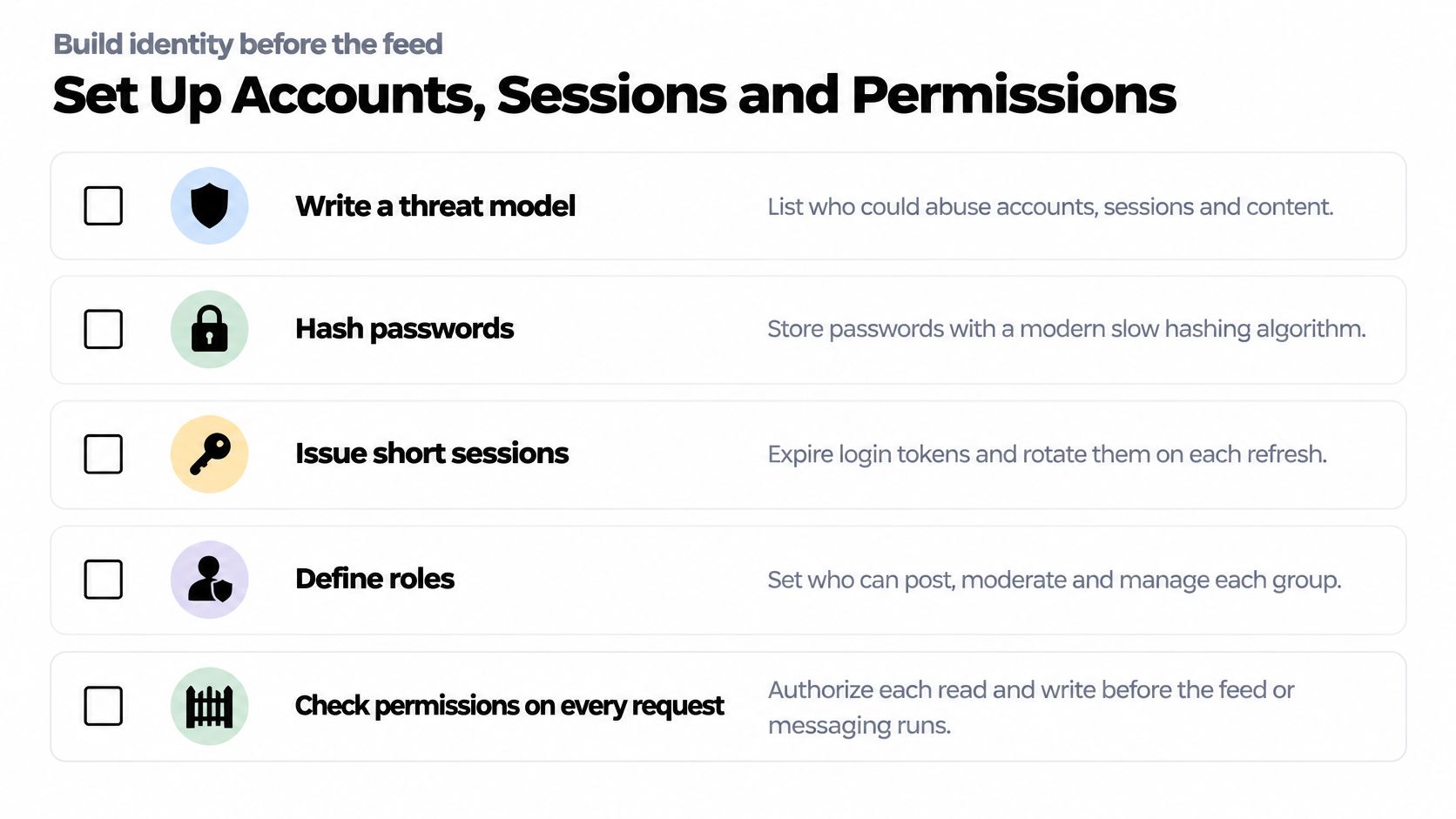
Build identity and authorization before the feed or messaging. Every later object needs an owner, an audience, and rules for changing it. Retrofitting those rules means auditing existing data as well as rewriting endpoints.
Use OWASP's MASVS implementation guidance to organize the security work. Its control groups cover storage, cryptography, authentication, network communication, platform interaction, code quality, resilience, and privacy.
Implement the security boundary
- Write the threat model. Cover account takeover, token theft, unauthorized object access, abusive automation, and privacy leakage. Describe the attacker's action and the consequence, not just a broad label such as insecure authentication.
- Map each risk to the relevant MASVS controls. Assign an implementation task and a test so the threat model doesn't become a document nobody revisits.
- Secure sessions. Require HTTPS, use short-lived access tokens, and protect refresh tokens in appropriate secure storage. Define logout, timeout, revocation, and account-recovery behavior together.
- Enforce object-level authorization on every post, comment, message, media object, and moderation action. Derive the acting identity from the validated session, never from a client-supplied user ID.
- Require re-authentication for sensitive actions, including changing an email address or password and deleting an account.
- Automate the permission matrix. Test successful requests and rejected requests through the API, not just through the interface.
Permission test matrix for every release
Assume ordinary member accounts below. Commenting and messaging also depend on the recipient's settings and the object's policy.
| Test Actor | Read a Followers-Only Post | Edit or Delete Someone Else's Post | Comment or Send a Message |
|---|---|---|---|
| Owner | Allowed on own post | Denied without a moderation role | Allowed under applicable policy |
| Follower | Allowed | Denied | Allowed under applicable policy |
| Blocked user | Denied | Denied | Denied |
| Unauthenticated user | Denied; public posts only | Denied | Denied |
| Deleted account | Denied | Denied | Denied |
| Expired session | Denied until re-login | Denied | Denied until re-login |
Ownership grants control over your own content, not someone else's. Give moderators separate, auditable capabilities rather than treating them as universal owners.
Close the less visible gaps
The dangerous failures aren't always on the login screen. Tokens stored in ordinary preferences, client-only permission checks, permanent session identifiers, and inconsistent recovery endpoints all undermine an otherwise polished flow.
Treat verification messages as part of that flow. An email verification email template can help with presentation, but the backend must enforce verification state and token validity independently.
Set a release gate of no unresolved high-severity authentication, authorization, or sensitive-data findings. A working login demonstration isn't evidence that another user's objects are protected.
Privacy Choices That Shape Your Database
Decide what you'll collect before the first account exists. In a 2025 survey, 63% of respondents expressed concern about social-media companies managing personal information, while 67% were concerned about children's online privacy and 62% about AI decisions using personal data, according to the New Zealand Privacy Commissioner's survey report.
Those concerns translate into schema and access decisions. Separate identity records from public profiles and content. In Supabase, write row-level security policies per table, including tables that clients aren't supposed to query directly.
Give each data type a purpose and an ending
- Identity data: Collect an email address, phone number, or birth date only when the product has a defined reason to need it.
- Consent records: Store the accepted policy version and timestamp. Keep optional tracking choices separate from essential service processing.
- Retention rules: Decide when deleted media, report evidence, logs, and backups expire.
- Third-party access: Maintain an inventory of analytics, notification, and other processors, with appropriate data-processing agreements.
Deletion needs a workflow, not a button that hides a profile. Track removal across content records, media storage, cached copies, and downstream systems. Explain any limited retention exceptions, including backup expiry, before confirming what has been deleted.
Offer a machine-readable export that a member can request without contacting an engineer. Test it using an account with posts, comments, uploads, and privacy preferences, not an empty test profile.
Privacy controls should change what the system stores and serves, not merely what the settings screen displays.
Personalization also needs a refusal path. When someone declines optional tracking, use recency and their chosen follow graph rather than disabling the feed. Collect only the behavioral signals you can justify, and explain their purpose in language members can understand.
Design the Feed, Data and Media Pipeline
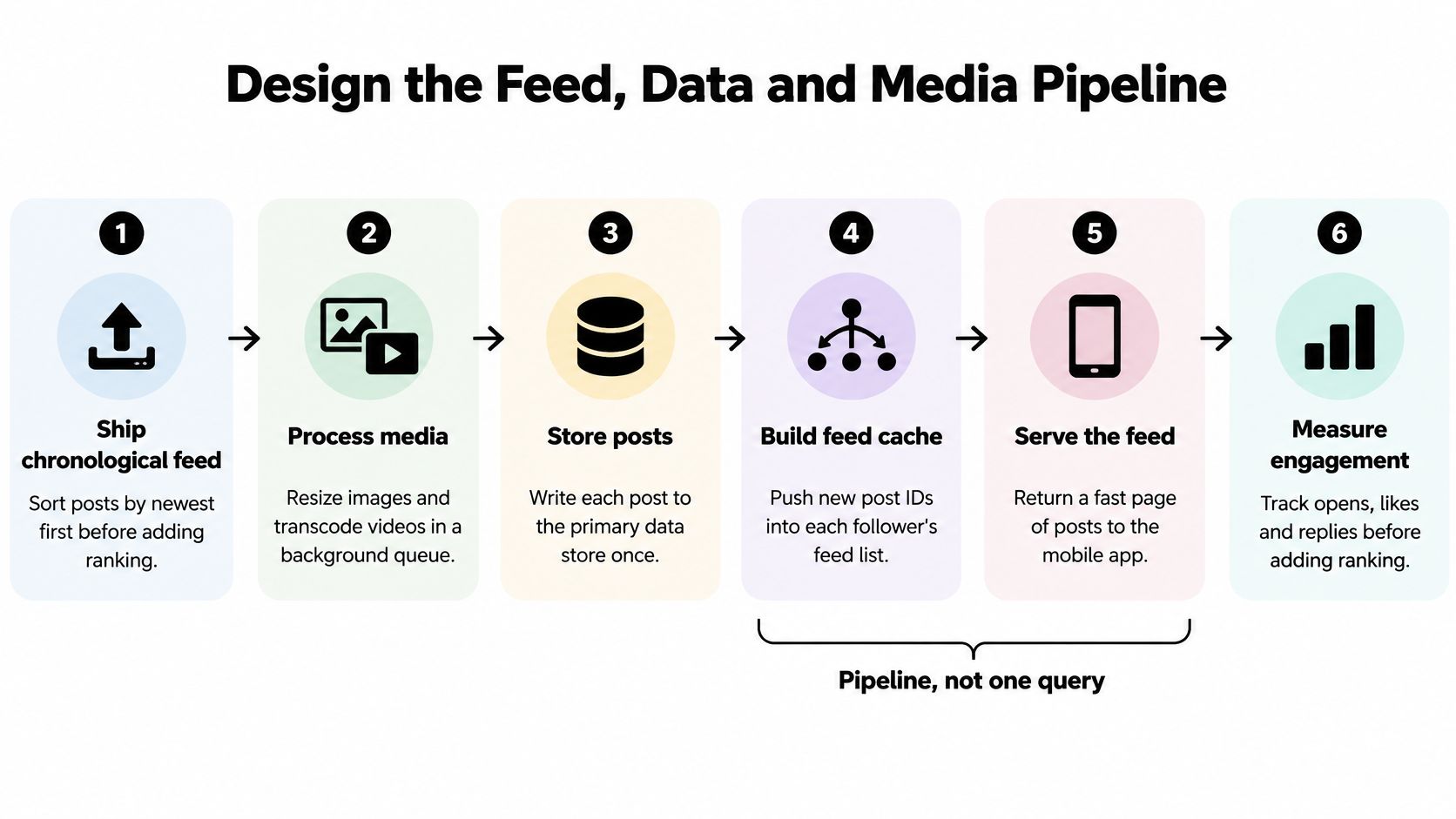
Launch with a chronological feed implemented as a measurable pipeline, not an endpoint that keeps accumulating joins and special cases. Add ranking only after you can distinguish useful participation from activity that merely keeps someone scrolling.
My default data-layer choice would be Postgres. Users, follows, posts, comments, reports, and permissions benefit from explicit relationships and transactional updates. Choose another store when a concrete requirement warrants it, not because a social app sounds too large for relational data.
Build the delivery path
- Ship chronological delivery. Establish correct visibility and predictable ordering before experimenting with recommendations. Keep the ordering stable when posts share a timestamp.
- Instrument impressions, opens, dwell time, likes, comments, shares, follows, hides, reports, and unfollows where your privacy policy permits. Attach stable experiment identifiers so you can compare changes without reconstructing assignments later.
- Separate responsibilities into modules. Ingestion, fan-out, ranking, media processing, notifications, and moderation need clear boundaries. They don't need separate deployed services at launch.
- Use cursor pagination rather than offsets. Add idempotency keys to post creation and reactions, and move fan-out and thumbnail generation into background jobs.
- Load-test the intended launch envelope. Define expected concurrent readers, posting volume, feed-request volume, and the largest permitted upload. Include retries, slow dependencies, and rejected requests.
- Set service-level objectives for tail latency, error rate, and freshness. Define alerts and rollback conditions before inviting members.
Keep media delivery separate from publishing
Create a media record with a processing state. Validate the upload, process it asynchronously, and expose the finished asset only when it passes the necessary checks. A post shouldn't pretend its video is ready while a transcoding worker is still running.
Use CDN-backed immutable URLs for suitable assets. Our guide to using a CDN for images covers delivery considerations, but caching doesn't replace access control. Private attachments need protected delivery and a deletion strategy.
For teams using our workspace, Supabase integration is included in the Free plan. That handles connectivity, not the responsibility to review schemas, policies, indexes, or migrations.
Test the failures that polished demos miss
Watch for N+1 queries, unbounded timelines, synchronous video transcoding, and duplicate notifications after retries. Batch related reads, bound each request, queue expensive processing, and make notification jobs safe to repeat.
Don't precompute every member's timeline automatically. Start with the simplest delivery model that meets your load tests, then add caches or fan-out where measurements justify them. Otherwise, you'll maintain infrastructure before you know which interaction people value.
Ship ranking changes through small randomized experiments. Use reports, blocks, hides, abandonment, and latency as guardrails, with automatic rollback when agreed limits regress. More reactions alone don't establish that a ranking change improved the community.
Moderation Operations From Day One
A report button without a queue, a reviewer, and an appeal route is a liability. It creates an expectation that someone will act without establishing how that happens.
Regulators and app stores increasingly expect reporting tools, timely feedback to reporters, parental controls for younger users, and measurable moderation activity. Treat those as design requirements, not post-launch paperwork. A small team can meet them, but only if the process is built before the first complaint arrives.
Define what happens after a report
Create categories for harassment, impersonation, spam, harmful content, and content involving minors. Assign each category a first-action rule, an escalation path, and an accountable reviewer. A general support inbox should never have to improvise policy under pressure.
Use automation for repeatable signals like duplicate spam and suspicious account creation. Reserve human judgment for appeals, ambiguous context, and serious edge cases. That split is what keeps a two-person team functional when report volume spikes.
- Preserve necessary evidence: Capture the relevant content before removal, restrict access, and apply the retention rules already defined.
- Record the decision: Log who acted, when, under which policy, and what changed.
- Notify the member: Name the rule, explain the action, and provide an appeal route.
- Separate the appeal: Have someone other than the original reviewer assess it.
Match access to review capacity
For younger users, default to private profiles, restricted messages from strangers, and no public location. Rate limits on follows and account creation make coordinated abuse harder to execute and cheaper to catch.
Don't open registration faster than your reviewers can handle the consequences.
Before launch, write response targets by severity and decide who covers which hours. Name a backup reviewer and an escalation contact. If the team can't provide continuous coverage, communicate its actual availability rather than implying otherwise. Users forgive stated hours. They don't forgive silence after a report.
Set a threshold for pausing invitations when unresolved reports exceed review capacity, and treat hitting it as a normal operating event rather than a failure. Include review tools, staff time, and appeals handling in the operating budget from the start. Automation can prioritize the queue, but a person still owns every decision that removes content or suspends an account.
Pick Your Build Path and Launch a Beta
A demo built in a weekend can still take months to make safe. Choose the route that matches your team's skills and requirements, then prove it with an invite-only beta where every feed action runs through the same permission tests you intend to ship.
Build routes compared
| Route | Control | Setup Speed | Main Risk |
|---|---|---|---|
| Build from scratch | Full control | Requires engineering setup and staffing | Engineering scope can overwhelm the schedule |
| Hired agency | Shared with the agency | Can reduce team-assembly work | Scope changes can become expensive |
| AI-assisted platform (AppJet) | High, with GitHub connection | Can reduce initial setup work | Must fit the required stack and workflow |
Building from scratch suits a team that needs unusual infrastructure or tightly controlled implementation choices. With an agency, settle code ownership, acceptance tests, handover, and operational responsibility before development begins. Both routes still need someone on your side making product and safety decisions.
With AppJet, you connect an existing GitHub repository or create a new project, then describe the change in plain language. The AI can build features, debug code, and refine the app with context from the project's structure, components, and business logic. Supabase integration and deployment to Cloudflare's global edge are part of the workflow, and GitHub login is required for repository-connected features.
The Free plan includes unlimited AI messages, private projects, full codebase understanding, GitHub integration, Supabase integration, global edge deployment with Cloudflare, and no use of data for training. No credit card is required to start. Starter includes everything in Free plus custom domains and virtual disk storage. AI messages are unlimited on both plans, so cost planning should focus on domains, storage, hosting, and operating time rather than message volume.
Invite members when the team is ready to learn
For native distribution, include submission preparation and review in your iOS and Android release plan. Hold the public date until you understand the applicable store requirements.
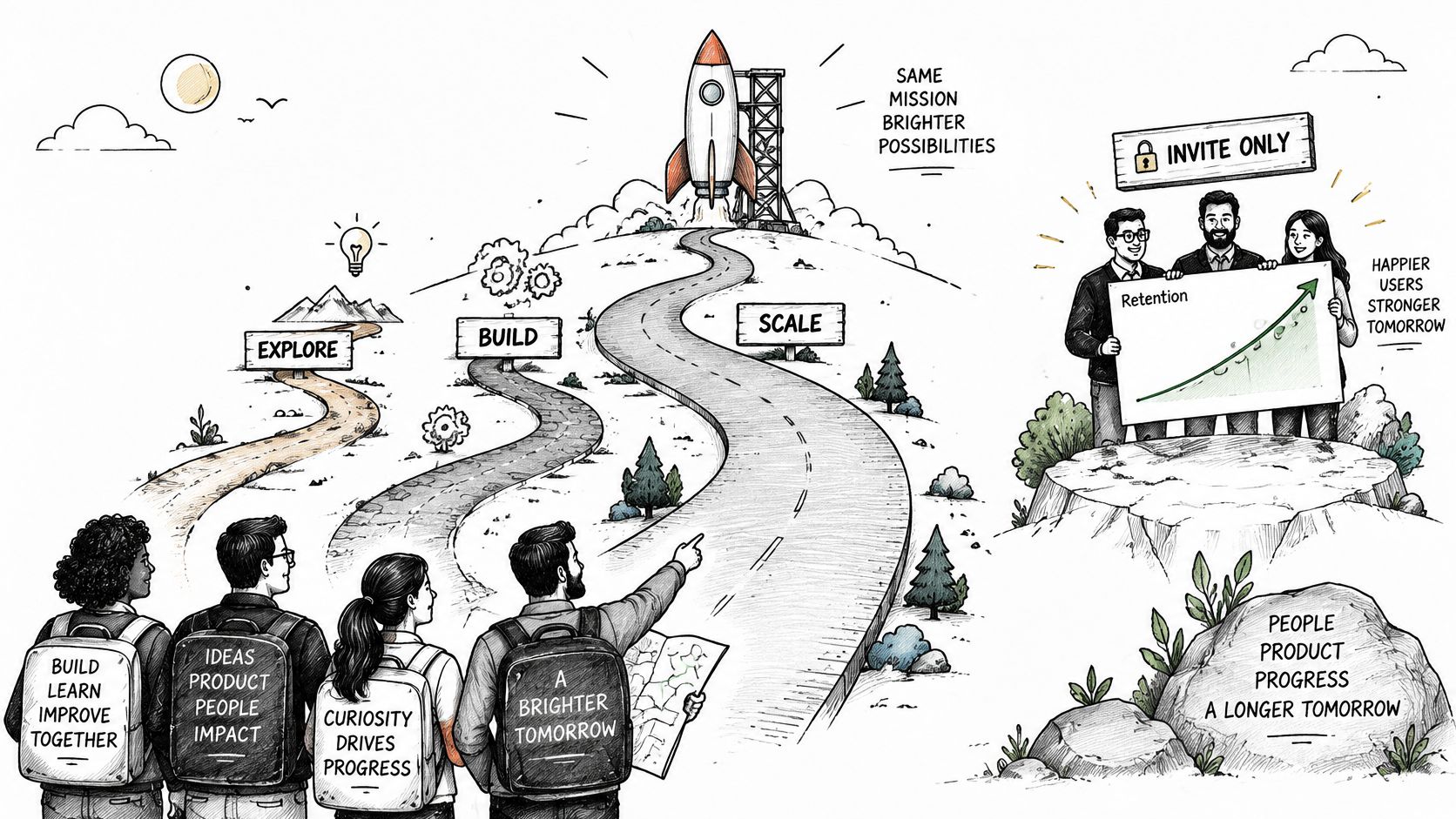
Invite a manageable group from the community you scoped. Use acquisition cohorts to compare return behavior, and treat likes as a secondary signal. Ask whether members get useful responses, can reach only the people your rules allow, and choose to contribute again.
To organize feedback and test distribution, use Uxia's guide to find tools for beta testing. Pick tools that fit your delivery channel and privacy requirements.
This week, write the scope statement, turn the permission matrix into test cases, and confirm who can act on reports during the beta window. Schedule the beta around those commitments.
AppJet brings AI-assisted development, GitHub connectivity, Supabase integration, and Cloudflare deployment into one workspace for building your social app. Visit AppJet to connect a repository or start a project, then implement your account rules and permission tests before expanding the feed.